Artificial intelligence is gradually becoming part of our professional lives. In industry too, it is beginning to transform the way people work, stepping in where it might not necessarily have been expected. Mechanical design is one such area.
Designing a product is not just about imagining its shape or building a 3D model. A designer’s day-to-day work involves many different tasks: finding a command, carrying out checks, creating documents, solving a problem or retrieving information.
Some of these tasks are essential. Others could be simplified.
This is precisely where artificial intelligence is beginning to find its place.
When AI becomes part of designer’s daily work
For a long time, AI may have seemed distant from the tools used by engineers. It is now capable of integrating directly into their working environment.
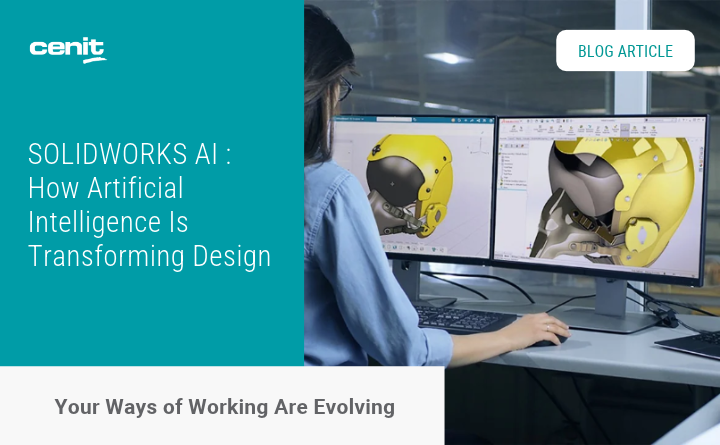
In CAD, this development is particularly interesting. For example, SOLIDWORKS AI can support certain stages of the design process, make tasks easier to perform and help designers access the information they need more quickly.
The change may seem subtle. Yet it is gradually changing the relationship between designers and their tools.
Where designers previously had to search, manipulate or check each element manually, certain actions can now be suggested, automated or supported by AI.
The tool is therefore no longer simply executing an action. It is beginning to play a more active role in the design workflow.
Making everyday tasks less time-consuming
In a design project, small tasks can quickly add up.
Finding a function, preparing a drawing, identifying an element in an assembly or understanding the source of a problem: each of these actions represents just one step in the overall process. But repeated across projects, they can take up a significant amount of a designer’s time.
AI makes it possible to rethink how this work is distributed.
It can handle certain operations, suggest an action based on the context or help resolve an issue. The goal is not necessarily to completely transform the design process, but to reduce tasks that take up time without being at the core of the designer’s expertise.
This may be one of the most interesting changes: AI is not simply adding new capabilities to a software tool. It can also change the way designers interact with their tools on a daily basis.
Human expertise remains at the center
This evolution naturally raises a question: what role will designers have as AI becomes increasingly integrated into their working environment?
The answer does not necessarily lie in replacing people with technology.
Designing a product means understanding a need, taking constraints into account, making choices and evaluating different options. These decisions rely on the professional’s experience and expertise.
AI can support certain stages of the process, but it does not understand the project in the same way as the person designing it.
The designer’s role therefore evolves rather than disappears. By spending less time on certain manual tasks, designers can devote more time to what brings value to their work: thinking, evaluating options, checking results and making decisions.
The goal is therefore not simply to work faster. It is also about working differently.
Towards more AI-assisted design
As artificial intelligence becomes increasingly integrated into CAD tools, a new way of working is taking shape.
AI can first make certain everyday tasks easier. Then, as it becomes better at understanding the working context, it can provide more advanced support to professionals.
This is one of the directions explored by SOLIDWORKS, with AI features directly integrated into the design environment, as well as the introduction of AI companions designed to support engineers in different areas.
This evolution reflects a broader shift: artificial intelligence is no longer simply about automating certain operations. It is beginning to become part of the way professionals work.
For designers, the question may therefore no longer be whether AI will have a place in their daily work, but how this new form of assistance can shape and evolve their practices.
The future of design may not be about choosing between humans and AI, but about how the two can work together.
To learn more, discover the possibilities offered by AI integrated into SOLIDWORKS.